In 28 Years Later, the world remains scarred decades after the devastating Rage Virus first erupted. Humanity struggles to rebuild, yet the threat of infection still looms large, and society is fractured into isolated pockets of survivors. On a remote island in the British Isles, a fragile community lives under constant vigilance, disconnected from the chaos of the mainland by both geography and fear.
At the heart of the story is Spike, a twelve-year-old boy raised on this island. His life is quiet, but shadowed by a grave worry: his mother, Isla, is gravely ill. She suffers from a mysterious sickness that weakens her memory and body, and the isolated settlement has scarce medical resources. Haunted by his mother’s fading health, Spike musters courage to leave the safety of the island and cross to the mainland with his father, Jamie, on a perilous mission: to find Dr. Ian Kelson, a doctor rumored to still practice medicine amidst the dangers of the post-viral world.
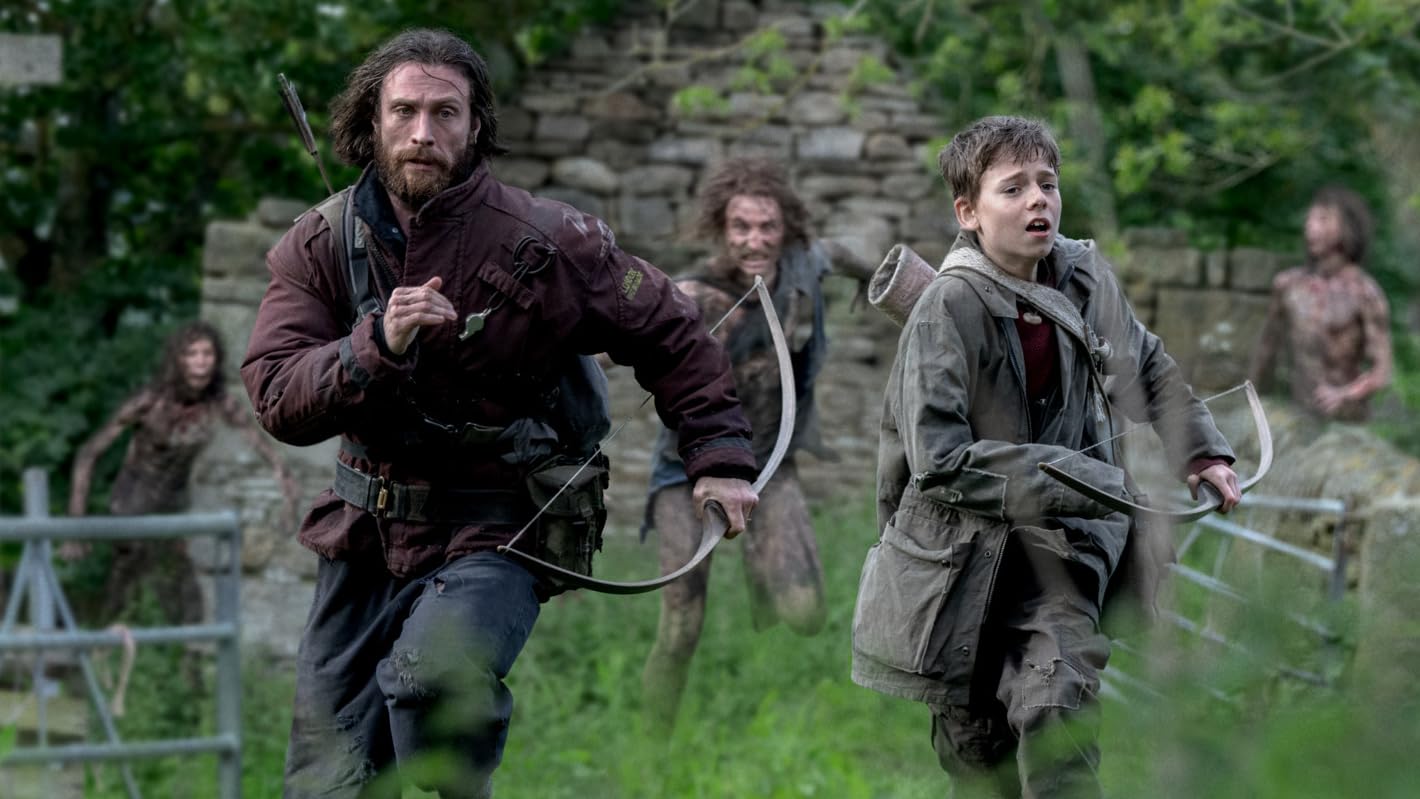
As they journey across the ruined countryside, Spike and Jamie face more than just the infected—they uncover a society that has evolved in unexpected and frightening ways. The infected are no longer all the same: mutations and variants emerge, and there are whispers of infected who are smarter, stronger, more organized than ever before. Meanwhile, on the mainland, Dr. Kelson lives among relics of the past: bones, memorials, and monuments that mark not just disease, but memory and loss.
Emotion plays as central a role as horror. Spike’s journey is not purely a physical adventure, but a coming-of-age tale, as he copes with grief, responsibility, and the burden of hope. Isla’s condition forces him to confront mortality, while his relationship with his father is tested by the harsh reality beyond their island. Their quest is fraught with inner and outer danger, and they must navigate not only the threat of the infected, but also the moral complexity of human survivors.

As the story unfolds, the film raises deeper themes about memory, isolation, and how societies remember trauma. The titular “28 years later” is not just a temporal marker but a meditation on how the virus has changed both bodies and minds, and how people reconstruct meaning in a broken world.
In the end, 28 Years Later offers a haunting and poignant vision: a post-apocalyptic world where survival is not enough, and healing means confronting the past. Spike’s journey remains open-ended, suggesting that reconstruction is a long road, and perhaps the greatest danger lies in forgetting what was lost.


